Film Information
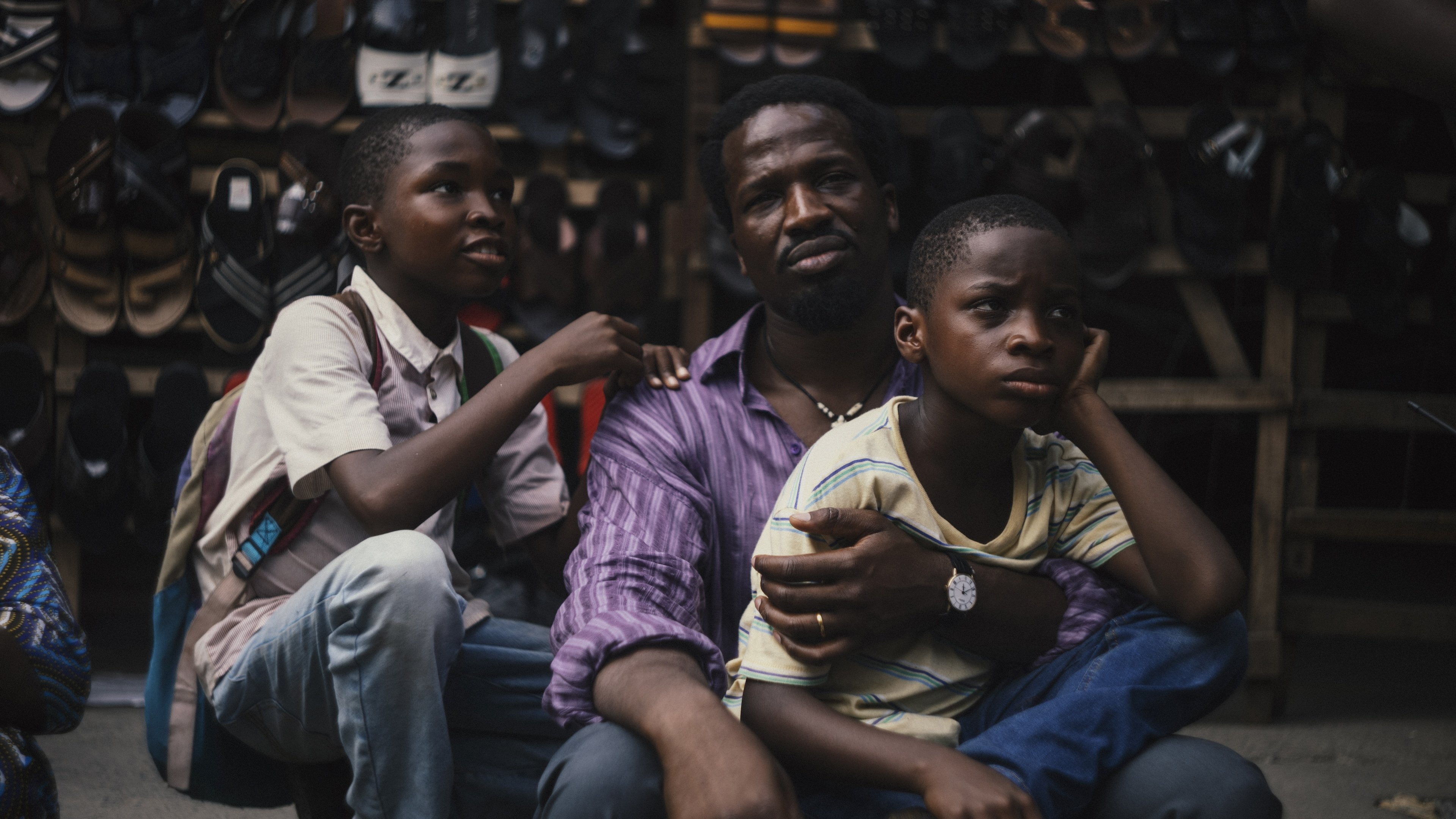
Folarin is the non-attendant father to two boys, Akinola and Olaremi, who have developed different personalities and boyhood as a response to Fola’s absence. My Father’s Shadow is a film that spotlights their off-chance one-day voyage from a Nigerian village (where Folarin’s wife and children live) to Lagos so that Folarin can collect the money owed to him by the factory he works for. Underneath this is an emotional journey between Fola and his boys, where he tries to bridge the distance between them.
In the background, Nigeria is experiencing great upheaval. The film is set during the 1993 election, which was annulled in a military coup. Most of its events span over a single day from the jubilant morning of the expected election results to the chaos of realisation in the evening. In a subtle way, the various characters, who echo cries about Nigeria’s progress, are also aware of what is looming, given the strong military presence throughout Lagos for the entirety of the film.
The themes of disconnection and disappointment are explored with great attention to Nigeria’s vast rural and urban landscapes, and the ways in which life has stagnated. Visually, the film captures the anxieties and pitfalls of the postcolonial continent where resources are scarce, politics is corrupted, and there is a struggle between different compasses for a way of life. A bus breaks down. The power goes out. Folarin has not been paid. Folarin has not returned home. Multiple supporting characters are also put on camera, with many voices combining to give an authentic profile of the Nigerian 90s through the perspective of Aki and Remi. Their innocent eyes are also very quick to understand. They see the excessive military presence. They see the injustices of the city. They see how much their father struggles to get ahead.
Yet, clearly, as the film’s title suggests, Folarin holds deep trauma, secrets and misgivings. Despite his charisma and courage, he struggles to earn the respect of his youngest son and opens up for the first time with his eldest. The film shows, but does not tell of Fola’s fragility and cowardice. It does the same for his steadfastness and bravery. Fola is a complex character, who is both a victim of unfortunate socio-economic conditions but is also shown to have a level of freedom over some of his decisions. After all, it is Fola’s will which carried his wife out of Lagos and his will which carries his boys back. He is the epicentre of the narrative and seemingly, both his sons have become the boys they are as different reactions to him.
Remi is meek and irresponsible. He was overly-eager to abandon his responsibilities and travel with his father to Lagos. He spends all his money too quickly. He does not adequately care for his younger brother. He takes after his father’s freewheeling nature and delicate demeanour. A shadow can be seen as a person’s copy. Remi, who was named after Fola’s brother, is Fola’s shadow in this sense. There is a deeply visual scene, reminiscent of Barry Jenkins’ Moonlight where Fola holds Remi in the waves. They bond over the joys and pains of their connection and disconnection.
Aki is defiant and suspicious. He chastises his older brother and challenges his father in much the same way. He sulks during the trip and is slow to heed his father’s advice. He takes responsibility, but also feels entitled. He takes after his father’s noncompliant and combative character. A shadow can also be seen as a person’s haunting. Aki is a reckoning for Folarin, bringing out the darkness that Fola tries to keep concealed. During that same scene in the water, Aki is on the beach attending to himself, focused on building his own identity without his father.
Around them is the city. The film makes sure to expand its gaze to both the vibrancy and vagrancy of Lagos. Some people beg on the streets. Some chop at whale meat on the beach. Many are liars. Some are cheaters. There are those that try to be guiding voices and some who are around for a good drink. Above all, there are endless stories. Almost all the characters they encounter have much to say. Nigeria is depicted as a nation enveloped in a narrative of itself, in much the same way that Folarin shares tales with his sons.
Folarin is a symbol of Nigeria itself. Both are torn with internal struggles and a noticeable dishonesty. Both are blooming with seeming potential. Both are more disappointed and disconnected than they admit. My Father’s Shadow emerges then as an earnest masterpiece which captures Black masculinity, African duress and the futility of holding on to something as ephemeral, fleeting, transient and momentary as the shadow of one’s father.